Info
Escobaria or Pelecyphora
Escobaria.cz - comment on the classification to the genus Pelecyphora
Info 027 - September 5, 2026
|

|
|
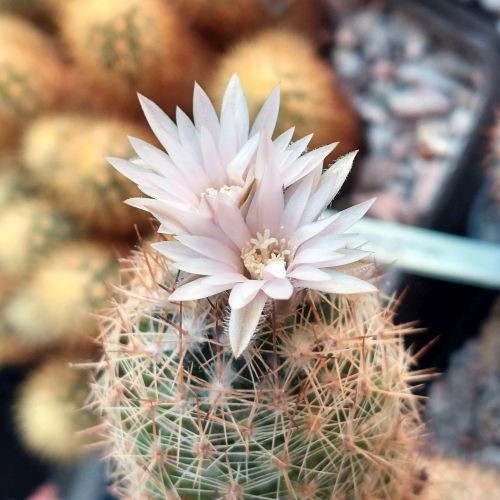
Escobaria tuberculosa (Engelm.) Britton et Rose type plant of the genus Escobaria |
Pelecyphora aselliformis Ehrenb. typ plant of the genus Pelecyphora |
The escobaria.cz website was created at a time when the classification of cacti was based primarily on differences in generative and vegetative organs (traditional morphological classification). Recently, however, there has been a rapid accumulation of molecular data and the development of a system based, for example, on DNA analysis and evolutionary relationships (phylogenetics). The main aim of modern taxonomy is to establish monophyletic groups comprising a common ancestor and all its descendants (cladistics). These new methods are thus overturning the previously used classification of individual taxa.
Following the publication of the article by Sánchez et al. (2022), which reported the reclassification of the genus Escobaria into the genus Pelecyphora (see Info 016), I therefore began to consider whether and how to incorporate this information into the website. The classification within the genus Pelecyphora itself was based on the results of molecular analyses of a limited number of samples, whilst, for example, significantly different morphological characters or topology were not taken into account, or at least not commented upon. In my view, the study bears the hallmarks of an attempt to claim priority in the classification of new taxa within the genus Pelecyphora. Other studies, such as that by de Vos, Eggli et al. (2025), show that the relationships between individual taxa within the 'mammilloid' clade are far more complex and less clear-cut, and the study needs to be supplemented with analyses of further taxa. The same applies to the placement of the taxon Ortegocactus macdougallii within the genus Cochemiea (see Info 021), as published in the paper by Breslin et al. (2021, 2022). Personally, I therefore tend to agree with the statement in the article by de Vos, Eggli et al. (2025) - " In view of these surprising placements (meaning the new information provided), and the often low support values, we regard the drastic approaches of Breslin et al. (2021) (to include Escobaria in Coryphantha s.l. and to include Neolloydia and Ortegocactus in Cochemiea) and Sánchez et al. (2022) (to include Escobaria in Pelecyphora) as premature, and propose a classification (see above) that more closely represents the inferred sequence of cladogenetic events in the group."
Cactinae Britton & Rose 1920 (as 'Cactanae')
Incl. Coryphanthinae Brittton and Rose 1923 (as 'Coryphanthanae'), incl. Bravocactinae Doweld 1998, incl. Pediocactinae Doweld 1999, incl. Turbinicarpinae Doweld 1999), incl. Cochemieinae Doweld 2000, incl. Epithelanthinae Doweld 2000, incl. Escobariinae Doweld 2000, incl. Pelecyphorinae Doweld 2000, incl. Mammillariinae Lakomski 2003 (nom. illeg.).
Included genera:
• Acharagma
• Ariocarpus (incl. Neogomesia, incl. Roseocactus)
• Cochemiea (incl. Bartschella, incl. Chilita, incl. Phellosperma)
• Coryphantha (incl. Escobrittonia, incl. Lepidocoryphantha)
• Cumarinia
• Epithelantha
• Escobaria
• Kadenicarpus (excluded from Turbinicarpus s.s.)
• Lophophora
• Mammillaria (incl. Dolichothele, incl. Escobariopsis, incl. Leptocladodia, incl. Mamillopsis, excl. Mammilloydia, excl. Oehmea; excl. Cochemiea). The remaining further segregates of Mammillaria have not been sampled as to type by us or by the studies discussed below and we tentatively continue to include them in u Mammillaria: Cryptocarpocactus, Fimbriatocactus, Krainzia, Porfiria, Pseudomammillaria, Solisia.
• Mammilloydia
• Neolloydia
• Obregonia
• Oehmea
• Ortegocactus
• Pediocactus (incl. Navajoa, incl. Puebloa, incl. Utahia)
• Peleyphora (incl. Encephalocarpus)
• Rapicactus (incl. Lodia)
• Strombocactus (incl. Chichimecactus)
• Turbinicarpus (incl. Gymnocactus, incl. Normanbokea, excl. Kadenicarpus, excl. Rapicactus).
(for further details, see de Vos, Eggli et al. 2025)
For the reasons outlined above, I have therefore decided to retain the current classification of the genera (Acharagma), Ortegocactus and Escobaria on the website for the time being. However, I will gradually add information on the genus Pelecyphora (the taxa P. aselliformis and P. strobiliformis). It has previously been demonstrated that the genus Acharagma belongs to the 'second' subclade within the 'mammilloid' clade. It is most closely related to the genera Rapicactus and Lophophora. At present, however, I do not intend to include information on these genera on the website. Should anyone, however, wish to compile information on the genus
Jan Mynář
Literature
Breslin, P. B., Wojciechowski, M. F., & Majure, L. C. (2021): Molecular phylogeny of the Mammilloid clade (Cactaceae) resolves the monophyly of Mammillaria. Taxon, 70(2), 308-323.
Breslin, Peter B.; Wojciechowski, Martin F.; Majure, Lucas C. (2022): Remarkably rapid, recent diversification of Cochemiea and Mammillaria in the Baja California, Mexico region, American Journal of Botany, 109(9): 1472-1487.
Kunte, Libor (2019): Kaktusy, otrněná krása. Profi Press s.r.o. Praha.
Sánchez, Daniel; Vázquez-Benítez, Balbina; Vázquez-Sánchez, Monserrat; Aquino, David; Arias, Salvador (2022): Phylogenetic relationships in Coryphantha and implications on Pelecyphora and Escobaria (Cacteae, Cactoideae, Cactaceae), PhytoKeys, 188: 115-165.
de Vos, Jurriaan M.; Eggli, Urs; Nyffeler, Reto; Larridon, Isabel; McGinnie, Catherine; Epitawalage, Niroshini; Maurin, Olivier; Forest, Félix; Baker, William J. (2025): Phylogenomics and classification of Cactaceae based on hundreds of nuclear genes, Plant Syst Evol, 311: 28.